
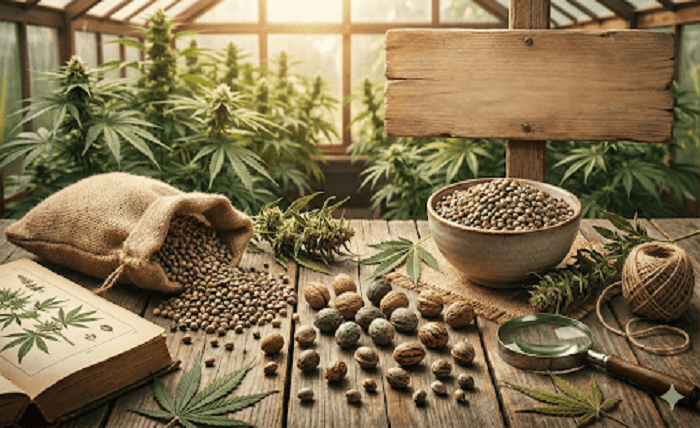
Marijuana Seeds: The Complete Collector’s Guide. How to Choose Wisely and Safely?
The world of cannabis genetics is a fascinating realm attracting an increasing number of enthusiasts and collectors. However, choosing the right seeds is not just a matter of aesthetics or a catchy strain name. It is a process that requires knowledge, an understanding of key parameters, and legal awareness.
In this article, we will guide you through the maze of terminology, give you tips on how to verify seed quality, and tell you what to look for when choosing a store (seed bank) to ensure your collection remains safe and valuable.
1. The Collector’s Alphabet: Deciphering Seed Types
Before you add a product to your cart, you must understand the meaning behind the specialized names. This knowledge is the foundation for any self-respecting collector.
Feminized Seeds This is currently the market standard. In nature, cannabis plants are dioecious (separate sexes). Feminized seeds are genetically altered to produce female plants in 99.9% of cases.
- Why are they popular? They guarantee genetic stability and are highly coveted by those who value the specific terpene profiles of a given strain.
Autoflowering Seeds Often called “autos.” They contain genetics from Cannabis Ruderalis (wild cannabis). Their defining characteristic is their independence from the light cycle—they flower automatically after reaching a certain age.
- For whom? For collectors who value unique crosses and resilient genetics that, in nature, can survive in difficult conditions.
Regular Seeds This is the classic, natural form of seeds from which both male and female plants can emerge.
- For whom? Mainly for purists and those interested in preserving a pure gene pool (breeding), in jurisdictions where this is permitted.
2. Indica, Sativa, or Hybrid? Differences in Genotype
Collectors often select seeds based on their geographical origin and genetic traits.
- Indica: Originate from colder regions (e.g., the Hindu Kush mountains). Genetically, they are characterized by a short, stout structure and broad leaves.
- Sativa: Originate from equatorial regions. Their genetic code dictates a tall, slender build with narrow leaves.
- Hybrids: A masterpiece of genetic breeding—a combination of both types mentioned above to extract the best traits (e.g., the vigor of a Sativa and the compact structure of an Indica).
3. How to Choose a Seed Store? Safety Criteria (E-E-A-T)
In the age of the internet, there are plenty of shops, but not all deserve your trust. Choosing a seed bank is a matter of data security and product quality. Here is a checklist you should apply:
- Reputation and Reviews Do not rely solely on the descriptions on the store’s website. Check independent forums. The collector community is very sensitive to scams and quickly verifies stores selling old or improperly stored seeds.
- Storage Methods This is a key technical aspect. Seeds are living organisms.
- Does the store state how they store their stock? Professional seed banks keep seeds in refrigerated conditions (usually 39-46°F / 4-8°C) with low humidity. If the store doesn’t mention this, you risk buying “dead” seeds with zero collector value.
- Original Packaging (F1 vs. Bulk) For a collector, value lies only in the seed within the original, sealed packaging from the breeder (e.g., Dutch Passion, Royal Queen Seeds, Barney’s Farm).
- Avoid single loose seeds from strange sources unless the store is an authorized distributor selling “bulk” seeds with a guarantee of origin.
- Data Security and Discretion In the cannabis industry, privacy is currency. Pay attention to:
- SSL Certificate: Is the connection to the site encrypted?
- Shipping Policy: Are packages discreet (“stealth”), without logos or indications of the contents?
- Data Deletion: Does the store offer a guest checkout option or declare that data is deleted after the order is fulfilled?
4. What to Look for Physically? (Seed Quality)
Once the seeds reach you, you can make a preliminary assessment of their quality (health), though remember—appearance does not always reflect genetics 100%.
- Color: Mature, healthy seeds are usually dark brown, gray, or black.
- Pattern: They often have characteristic “tiger stripes” or spots.
- Hardness: A healthy seed should be hard. If it cracks under light finger pressure, it is immature or old and not suitable for a collection.
- Sheen: They often have a slight, waxy sheen. Matte, green, or white seeds are usually immature.
5. Summary: Responsible Collecting
Building a marijuana seed collection is a passion that combines a love for botany and genetics. However, to be satisfying, it must be based on knowledge and safety.
Remember:
- Buy only from reputable stores that care about product freshness.
- Choose original breeder packaging.
- Always keep local laws in mind.
- Your collection is an investment—choose quality that will stand the test of time.